RBD 永久缓存
共享、只读的父映像缓存
Cloned RBD images from a parent usually only modify a small portion of
the image. For example, in a VDI workload, the VMs are cloned from the same
base image and initially only differ by hostname and IP address. During the
booting stage, all of these VMs would re-read portions of duplicate parent
image data from the RADOS cluster. If we have a local cache of the parent
image, this will help to speed up the read process on one host, as well as
to save the client to cluster network traffic.
RBD shared read-only parent image cache requires explicitly enabling in
ceph.conf. The ceph-immutable-object-cache daemon is responsible for
caching the parent content on the local disk, and future reads on that data
will be serviced from the local cache.
Note
RBD shared read-only parent image cache requires the Ceph Nautilus release or later.
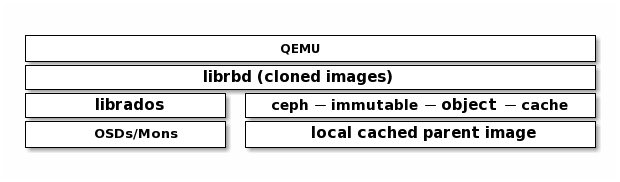
不可变对象缓存守护进程
The ceph-immutable-object-cache daemon is responsible for caching parent
image content within its local caching directory. For better performance it’s
recommended to use SSDs as the underlying storage.
The key components of the daemon are:
Domain socket based IPC: The daemon will listen on a local domain socket on start up and wait for connections from librbd clients.
LRU based promotion/demotion policy: The daemon will maintain in-memory statistics of cache-hits on each cache file. It will demote the cold cache if capacity reaches to the configured threshold.
File-based caching store: The daemon will maintain a simple file based cache store. On promotion the RADOS objects will be fetched from RADOS cluster and stored in the local caching directory.
On opening each cloned rbd image, librbd will try to connect to the
cache daemon over its domain socket. If it’s successfully connected,
librbd will automatically check with the daemon on the subsequent reads.
If there’s a read that’s not cached, the daemon will promote the RADOS object
to local caching directory, so the next read on that object will be serviced
from local file. The daemon also maintains simple LRU statistics so if there’s
not enough capacity it will delete some cold cache files.
Here are some important cache options correspond to the following settings:
immutable_object_cache_sockThe path to the domain socket used for communication between librbd clients and the ceph-immutable-object-cache daemon.immutable_object_cache_pathThe immutable object cache data directory.immutable_object_cache_max_sizeThe max size for immutable cache.immutable_object_cache_watermarkThe watermark for the cache. If the capacity reaches to this watermark, the daemon will delete cold cache based on the LRU statistics.
The ceph-immutable-object-cache daemon is available within the optional
ceph-immutable-object-cache distribution package.
Important
ceph-immutable-object-cache daemon requires the ability to
connect RADOS clusters.
ceph-immutable-object-cache daemon should use a unique Ceph user ID.
To create a Ceph user, with ceph specify the auth get-or-create
command, user name, monitor caps, and OSD caps:
ceph auth get-or-create client.ceph-immutable-object-cache.{unique id} mon 'allow r' osd 'profile rbd-read-only'
The ceph-immutable-object-cache daemon can be managed by systemd by specifying the user
ID as the daemon instance:
systemctl enable ceph-immutable-object-cache@immutable-object-cache.{unique id}
The ceph-immutable-object-cache can also be run in foreground by ceph-immutable-object-cache command:
ceph-immutable-object-cache -f --log-file={log_path}